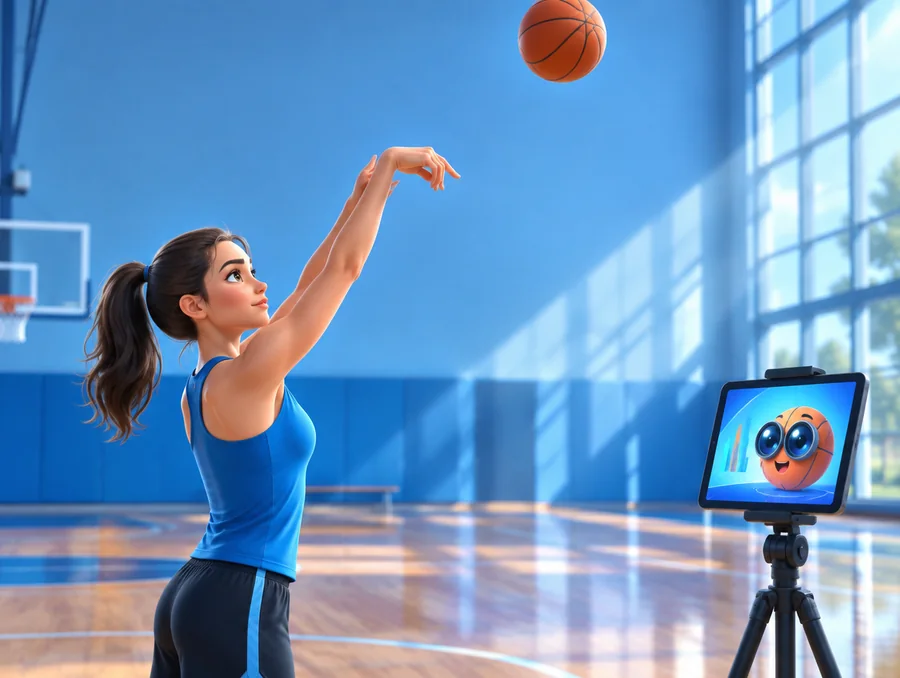
The whole pitch, in your companion's world. Sound on.
Draft video. Stock footage from Pexels; replace with real Hooper Buddy sessions once recorded.
Even if you do not have a coach, a trainer, or anyone to rebound for you. Point your webcam at yourself, put shots up, and Hooper Buddy scores your elbow, release and follow-through on every rep, talks you through it out loud, and remembers how you are improving from one session to the next.
Pose tracking runs in your browser and nothing is uploaded to do it. Only your scores go to the coach. A recording leaves your device only when you choose to save it to the Cloud Vault.
You put up hundreds of shots and nobody tells you what changed between the ones that dropped and the ones that did not.
You practice alone. No coach on the driveway, no trainer at the park, no one watching your elbow at 9pm in the gym.
You cannot see yourself. You feel the shot, but you cannot watch your release angle and shoot at the same time.
Private lessons are expensive and rare. One hour a week with a trainer covers a fraction of the reps you actually take.
Your kid wants feedback, not a lecture. Parents want to help and do not always know what to say about a jump shot.
Nothing is tracked. Six months from now you will have taken thousands more shots and still not know whether your form improved.
Every session without feedback is a session where the same habit gets reinforced. Imagine instead ending every workout knowing the one thing to fix tomorrow, in your companion's own words.
Motion capture, joint tracking, form breakdown: professional athletes have had it for a decade, in rooms that cost more than a house. Here is the whole story in fifteen seconds.
These are illustrative animations, not recordings of the app. What the app actually does is further down this page, in plain words.
Real-time body tracking used to need a lab, sensors, or a studio. Now it runs inside a browser tab on a normal laptop.
Introducing Hooper Buddy: the AI companion that scores every rep, coaches you out loud in real time, and remembers you between sessions.
Elbow under the ball, release angle, follow-through hold. Three scores land the moment your arm comes down.
Short live reactions on every rep. Ask "how did I do?" and get one thing to fix, in the form language of Kobe, Curry, Jordan and Ray Allen.
Every session, transcript and report is kept. Open the Brain and see what your companion has learned about you.
No wearables, no sensors, no uploading video. Your webcam and a browser tab.
Head, shoulders and both arms in view. Pose tracking runs on your own machine, so nothing is uploaded to score a rep.
Elbow under the ball, release angle, and how long you hold the follow-through. Three numbers, one overall, instantly.
Short live reactions while you shoot. Ask "how did I do?" for real coaching. A full spoken report when you end the session.
Every session, every transcript, every report is kept. Open the Brain view and see what your companion knows about your game.
Say "start a session" and the camera comes on. Say "show me what you remember" and the memory map opens. Voice in, voice out.
Stream the SoulTown Music station while you train, radio clean. Choose whether your companion talks over the music or stays quiet until you ask.
On Pro and up, every camera session records with the skeleton overlay into your Vault on your device. Watch it back, download it, delete it, or save it to the Cloud Vault to keep it across devices. Basic has no recordings.
Not only solo training. Start a run for a game, an open run or a team practice: the camera grades how you move, a person taps what the ball did, and the card says which is which. See how that works.
Age bands, safe mode, and a parent PIN that locks personality and age settings. Younger players get clean, encouraging coaching only.
This is the live HUD during training. Scores land the moment your arm comes down.
Training is you and the camera. This is the rest of your basketball: a real game, a Saturday open run, a team practice. Put the laptop where it can see the floor, start a run, and play.
Thirty-three body points, read in your own browser, turned into scores by our code. This is the half nobody has to remember to tap.
One tap, or one word out loud. The app writes it down with the second it happened and who said so, and it never pretends it saw it.
The camera sees a body. It has no ball, no hoop, no jersey and no face, so it cannot see a shot go in and it never claims it did. Anything about the ball is logged by a person. Every figure on the card carries the word MEASURED or LOGGED beside it, on the screen and in anything you send a coach, so nobody ever has to guess which is which.
Fatigue drift is the change from this player's own first reps to their last, not a judgement about their fitness. An uncalibrated movement score is a rough guide until the player runs the short calibration and the app learns their ranges.
Example card. The layout is real, the numbers on it are made up to show it. Nothing here is a player's result.
It still plays like a card. The run ends on an element, Fire down to Air, the same meter that grades a training rep, and it feeds the points and badges the rest of the app already runs on. The card is the fun. The label under every number is the point.
Game and open run mode is part of Pro and Elite, and of every seat on a Family, Team or League plan. The roster and the coach view are Team and League. Basic does not record, so it does not have this.
Every team, season, milestone and logged game in one place, beside the shooting the app measured itself. Built so a coach can read it in a minute and so a thirteen year old is never handed a verdict about their future.
The shots you put up yesterday, the count from last week, the month behind that and the season behind that. Attempts and form scores come straight out of the sessions this app recorded, so nobody types them in and nobody can move them.
Middle school, high school, AAU, club, college, adult league, semi pro, pro, national team. Each one with the season, the role and the dates.
Minutes, points, rebounds, assists, steals, blocks, turnovers and the shooting splits, entered by the player or whoever keeps their book. It is marked logged everywhere it appears, because nothing checked it.
First AAU team, a championship, an all-star selection, a signed NIL deal. A record of what happened, entered as a fact. The app never advises on any of it.
Shooting, finishing, passing, ball handling, on ball defense, team defense, rebounding, boxing out, screening, footwork, conditioning and the mental side. Each one carries what good looks like, drills you can actually run, and the specialists whose technique is publicly documented, with what we read cited underneath.
Nine traits, one to five, rated by the player, by a coach, or by teammates as an aggregate of three or more that is never attributed. There is no overall grade anywhere and there never will be: a single score on a kid reads as a verdict, and what actually helps is watching each trait move.
No projection, no pace, no grade. Three sessions shows three sessions. A month with nothing in it says nothing logged, in those words. Measured and logged never get added together into one number, on this page or anywhere else in the app.
Hooper Buddy studies publicly documented technique and cites what it read. Those players are not involved with this app, they do not endorse it, and nothing here is a quote from them.
Fourteen characters, one job: real-time guidance while you play, and support that remembers you between sessions. Pick a face, pick a personality, pick a language. Buddy scores basketball today, eight more are ready to talk while their sports come online, and five are still in the works.
A meter fills at your shooting hand as your arm rises, and the moment the shot completes it grades how aligned that rep was with the best in your sport. Not good or bad. Aligned. Five elements, one per tier, and on Pro and up every one of them is burned into your recording so you can watch it back.
On fire. That is the form. The rep that looks like the film.
Sparking. Heating up. Really solid, one detail from fire.
Grounded. Rocks rising. A solid base to build on.
Finding the flow. Not there yet, and moving the right way.
Set your sails. Every rep is wind toward better.
Your session earns an element too: form alignment plus makes once you mark your shots.
More than a scoreboard. A companion you sit down with, and a record of everything you did.
Open the Companion Room and your character fills the screen. Pick a recorded session and it pulls the video up and talks you through that session from the scores it recorded at the time, rep by rep. It is not watching the picture with you, and it does not pretend to. Say "pause" and ask about the moment.
Every training day on a calendar, every conversation with your companion filed automatically, your own notes and moods, all in your account.
Weight, height, BMI, water, sleep, resting heart rate, by the day. Nutrition sits beside it below. Wearable and ring integrations are next; the data model is already built for them.
The full station inside the app: now playing, seek, rewind, stop, save any track to a playlist, and meet the artists behind the music.
Photograph the plate or log it by hand, track what you drink, and let your companion read your food, your water, your sleep and your sessions as one picture instead of four apps that never talk to each other.
Point your camera at the food and it comes back as calories, protein, carbs, fat, fiber, sugar and sodium, with how sure it is. It is an estimate. You fix anything that looks off first, and nothing is logged until you save it.
Name, meal type, ingredients, macros, date and time. Filter your meals by date range or type, open any one of them, edit it or delete it.
Set your daily goal, add 250ml or 500ml in one tap, undo the one you did not mean. Water counts fully, everything else counts eighty percent toward the goal, and the app says so on the screen.
Days logged in a row, calories over time, the split across breakfast, lunch, dinner and snacks, and what you drank day by day.
An insights pass over the last fourteen days of meals, drinks, sleep and sessions together, in your companion's voice, ending on the one thing to change.
Nutrition is one of the scopes a player can open to a parent or a coach, for a number of days they choose. It is closed until they open it.
This is fuel for training, not a diet product. Hooper Buddy does not set a calorie target for a player under 18.
Every companion is built the same way we build every character at SoulTown Music: an identity, an archetype, a voice, a locked hero frame, and a 360 turntable sheet so it looks the same from every angle in every app, video and game. Under the character sits a Study Brain.
Shooting is where most tools stop. Your companion coaches defence, rebounding, boxing out, passing, footwork and the mental side, and it works from what the people who did those things best actually did.
Hooper Buddy studies publicly documented technique and cites what it read. Those players are not involved with this app and do not endorse it. The body tab is training information, not medical or dietary advice.
Each companion has its own research agent. It works through a curriculum for its sport, named players and positions, reading public game film and coaching, then files what it learns as memories with a source. When your companion tells you to hold your follow-through, it can name the player it learned that from.
Memories are pulled into every coaching reply and end-of-session report, so the advice traces back to real film, not vibes.
On the admin side the whole memory is a 3D neural map: every companion a cluster, every memory a node you can open, edit, or delete.
Ask the brain what it knows, tell it to fix a memory, or say "delete everything about free throws." It does it and shows you what changed.
The Study Brain runs entirely on Cloudflare: a fast model for live coaching, a stronger reasoning model for the deep synthesis, and hard limits per player so it never runs away. No other AI company sees your data.
Nine personalities, from a Kid Coach built for eight year olds to regional hooper voices that sound like the courts they came from. Fun mode is the default. Say "lock in" and every one of them drops the jokes and coaches you straight.
Bright, playful, celebrates effort. Superhero elbows and rocket follow-throughs.
Direct, warm, no slang. Sounds like someone who actually played.
Dade County energy. Bilingual flavor, loud, loyal, all heart.
Five boroughs, park ball, quick wit, no wasted words.
Laid back California hooper. Smooth, chill, secretly detail obsessed.
Baton Rouge to New Orleans. Soulful, musical, real talk with love.
Hype, current, keeps it real.
Chaotic good, playful, very online. Kept PG.
Warm, a little self-aware, mild pop-culture energy.
Regional and slang personalities unlock at 13 and up. Under 18 runs in safe mode: no profanity, always encouraging, parent PIN protected.
The SoulTown Music station streams right inside the app, clean and gapless, like a real radio. It is included on every plan at no extra cost, and it is original music, cleared for you to train to. Put your headphones on, start your session, and your companion either talks over the music with the volume dipping under its voice, or stays quiet until you ask. Your choice, one tap.
Crossfaded tracks, no gaps, volume that ducks under coaching and comes right back.
Companion talks over the music, or goes text-only while a track plays.
On Pro and up, sessions record into your Vault on your device. Save any recording to the Cloud Vault to keep it across devices.
Cutting those recordings into short clips automatically is an Elite feature that is not built yet. It is written up in what is not built.
Points and badges for showing up, friendly challenges you can start in a minute, a ladder that begins again every week, and a squad of people you actually know. All of it is free on every plan. There is nothing to buy and nothing to win but the top of the board, and a player under 18 competes inside their own family or team, never with strangers.
Your points are worked out from what you actually logged: sessions trained, days in a row, meals, journal entries, body logs. They are recalculated from your own record every time, so there is no stored number for anyone to move. Training days in a row are worth the most, because training is the point of the app.
Badges across training, consistency, nutrition, journal, competition and curiosity, with a few that are genuinely hard to get. The ones you have not earned sit on the shelf dimmed, with what earns them written underneath. Your level has a name and it moves as you train. No level unlocks a feature.
Give it a title, pick what it scores, average element, average form, or makes out of attempts, then set how many shots and how many days. Share the join code and they are in. Free to create, free to join, no entry fee, no prize pool, no cash.
Your row on a challenge board or a ladder is read on our side, out of a session that is already in your account. There is no box anywhere in the app to type a final score into. A board scored on form is measured from your body. A board scored on makes rests on the made or missed you marked at the time, same as everywhere else, and it says so on the board.
Rank inside your squad, inside a team you belong to, or against everyone. Every row shows a handle, a score and an element, never an email, a real name, a location or an age. The global ladder is adults only and stays off until an adult turns it on.
Add people by email or by a share code and see their element of the day and their streak, and nothing else. No messages, no comments, no bios between players anywhere in this app. That is deliberate: with nothing to type at each other, there is nothing to moderate. Blocking works in both directions at once, and a report is filed for a person to read, not handed to an automatic punishment.
Built for families first. Here is where it fits.
These are illustrations of where the app fits, not photographs of real sessions.
Type your email, we send you a link, you tap it and you are in. The link works once and expires in fifteen minutes, so there is no password to forget and none to steal.
Every plan includes the live webcam scoring. Recordings start at Pro, and so does game and open run mode.
| Basic$49/mo | Pro$99/mo | Elite$199/mo | |
|---|---|---|---|
| In every plan | |||
| Live form scoring on every rep (elbow, release, follow-through) | ✓ | ✓ | ✓ |
| Spoken reactions while you train | ✓ | ✓ | ✓ |
| Session history and shot log | ✓ | ✓ | ✓ |
| The element meter, Fire down to Air | ✓ | ✓ | ✓ |
| Nutrition, hydration and the photo estimate | ✓ | ✓ | ✓ |
| Body and health log | ✓ | ✓ | ✓ |
| Hooper Journal and the check in | ✓ | ✓ | ✓ |
| Player record: teams, games, milestones, NIL | ✓ | ✓ | ✓ |
| The skill tree and its drills | ✓ | ✓ | ✓ |
| Ratings across nine traits | ✓ | ✓ | ✓ |
| Points, badges, challenges and the weekly ladder | ✓ | ✓ | ✓ |
| SoulTown Music streaming | ✓ | ✓ | ✓ |
| Calendar and the private subscribe feed | ✓ | ✓ | ✓ |
| Coaching | |||
| Companions and personalities | 1 / 1 | All 9 / all 9 | All 9 / all 9 |
| Languages | English | 6 | 6 |
| Ask "how did I do?" mid session | − | ✓ | ✓ |
| Spoken end of session report with a drill | − | ✓ | ✓ |
| The memory map | − | ✓ | ✓ |
| Parental controls, safe mode and the parent PIN | − | ✓ | ✓ |
| Recording, game and open run | |||
| Session recording with the skeleton overlay | No recordings | ✓ | ✓ |
| Cloud Vault storage | − | $10/mo included, then $0.075 per GB/mo | $10/mo included, then $0.075 per GB/mo |
| Game, open run and team practice mode | − | ✓ | ✓ |
| The full stat card after a run | − | ✓ | ✓ |
| Dribble, stance, balance, box out and first step scoring | − | ✓ | ✓ |
| Fatigue drift across a session | − | ✓ | ✓ |
| Elite only | |||
| The AI video companion on screen | − | − | ✓ |
| Universal sport unlock | − | − | ✓ |
| Household sharing for up to four players | − | − | ✓ |
| Play style recording | − | − | ✓ |
| Automatic clips from a recording | − | − | Not built yet |
Family, Team and League buy seats. A seat carries the Pro column above, and the group plan adds the roster, the coach or parent view, and the sharing controls on top. Prices for those are below.
Monthly. Cancel any time from your account. Prices in USD. Basic works out to $1.63 a day, Pro to $3.30, Elite to $6.63: less than one private lesson a month on any plan. Cloud Vault storage past the included amount is a separate monthly storage bill, shown live on your Vault meter before it ever charges.
Live form scoring and a companion that talks while you train. No recordings at this level.
Everything in Basic, plus recordings, game and open run mode, and a companion that coaches, remembers and reports.
Everything in Pro, plus the play style recording, the video companion and the universal sport unlock.
One bill, one roster, and a rule that does not bend: the player decides what the group can see, scope by scope, and until when.
Up to four players in one household, one bill, a parent view of every player who chooses to share.
A coach dashboard with a shared brain across the roster. Every player controls what the team sees and for how long.
Fifty seats and up for leagues, schools and academies. Volume pricing, one invoice, org-level admin.
Billing for Family, Team and League is not open yet. Groups that join now start as a trial: create the group, invite your players, set roles and use the dashboards, and nothing is charged until checkout exists and you say yes to it. Questions about a roster or a league? Email team@hooperbuddy.com.
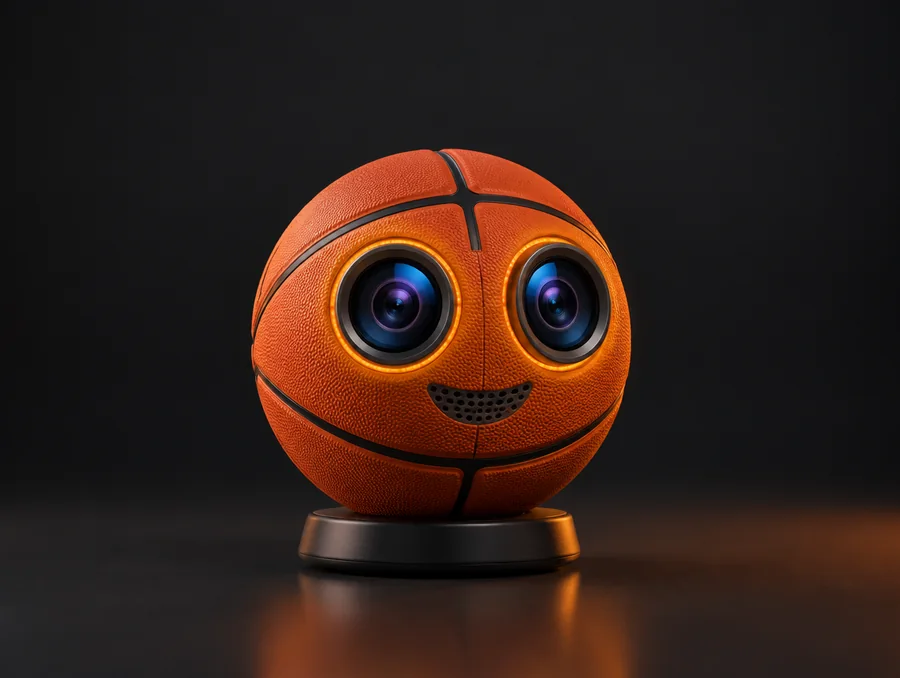
Today it runs on the phone, tablet or laptop you already own. What we want to build next is the thing on the right: a portable Hooper Buddy, shaped like your ball, with the cameras where its eyes are.
This is a concept render of something we have not built. There is no price, no release date and no preorder, and nothing on this page includes it. It is here because it is where we are trying to take this, and we would rather show you than not.
You are being asked to pick a plan, so you should know what you are buying now rather than what we hope to ship. These two are the ones worth naming on their own. Anywhere else on this page that something is still coming, it says so on the spot.
If you find anything else on this page that does not do what it says, email team@hooperbuddy.com and we will fix the page.
Keep shooting alone. Six months from now you have taken thousands more reps and still cannot say what changed.
Join the waitlist today. When your plan opens, your first session is scored, coached out loud, and saved before you leave the gym.
Not to score you. Pose tracking runs inside your browser, and the only thing sent to our server from a session is the numbers: attempts, scores, and whether you marked a shot made or missed. Two things do leave the device, and only because you ask them to: a recording you save to the Cloud Vault, which is Pro and up, and a photo of a meal you send to be estimated. Both sit in your own storage and you can delete either one. See the privacy policy.
No, and it never says it does. The camera reads thirty-three body points. There is no ball in that data, no hoop and no scoreboard, so makes, misses, rebounds, assists and everything else about the ball is logged by a person, by one tap or by saying it out loud. What the camera measures is how you move: form, dribble, stance, balance, box out, first step, and how those drift as you tire. Every number on every screen carries the word measured or logged beside it.
It can score more than one body in frame, and it cannot tell you whose body is whose. You assign them. On a Team or League account you can attach a tracked player to their Hooper Buddy account, and the run is only written onto their record if they have opened that scope to the group. A player under 18 is only added by an owner, a coach or a parent of a group they already belong to. Anyone else is a label on the roster with no account and no stats stored against them.
No. A camera across a court cannot resolve an expression, and inferring how a child is feeling from a webcam is not something this app will do. When a session needs that, it asks the player, one tap or one line in the journal, and stores the answer as their own words.
A laptop or desktop with a webcam and Chrome. Enough room to stand about seven to eight feet back with your arms fully extended overhead still in frame. A ball and a hoop are optional; form shooting counts.
Basketball shooting form is live. Eight more companions are ready to talk today and five are still in the works; scoring for their sports ships one at a time, and Elite members get each one the day it lands.
Yes, with controls. Pick a player age, and younger ages lock the slang personalities and force safe mode. A parent PIN protects those settings. No footage is uploaded to score a rep, and a recording only leaves the device if someone saves it to the Cloud Vault. Details are in the children's privacy section.
Only what you open to them, and only until the date you set. Sharing is scope by scope: sessions, journal, nutrition, body log, Vault. You can end a share early, and every time someone opens your data it is written to the group's log.
Email team@hooperbuddy.com. Support, billing, families, teams and leagues all land in that inbox.
Yes, monthly billing, cancel any time from your account. You keep access through the end of the period you paid for.
Not yet. The pose model and camera pipeline are built for laptop and desktop webcams first.
P.S. The demo is real and it is free. Open it, step back from the camera, and put five shots up. If your companion cannot tell you something true about your elbow in those five shots, you have lost nothing but two minutes.
Questions before you join? Email team@hooperbuddy.com.
Refund policy: not yet decided. Do not publish a guarantee until Michael sets one.